
GSTN - Cups Build documentation: Difference between revisions
No edit summary |
No edit summary |
||
| (One intermediate revision by the same user not shown) | |||
| Line 104: | Line 104: | ||
Structure at GSTN : The HP Laserjet Pro M202dw printers act as print servers and authenticate against the Samba AD. | Structure at GSTN : The HP Laserjet Pro M202dw printers act as print servers and authenticate against the Samba AD. | ||
<div style="color:#00000a;">[[Image: | <div style="color:#00000a;">[[Image:GSTNCUPSBUILD5.jpg]]</div> | ||
== 5. CUPS Access Control. == | == 5. CUPS Access Control. == | ||
| Line 111: | Line 111: | ||
<div style="color:#00000a;">[[Image: | <div style="color:#00000a;">[[Image:GSTNCUPSBUILD6.png]]</div> | ||
Latest revision as of 06:06, 1 February 2019
CUPS (Common Unix Printing System)
As is Build for CUPS
Date : 27.08.2016
Document Version : 1.0
Table of Contents:1. SAMBA integrated CUPS ( Print Server )3
1. SAMBA integrated CUPS ( Print Server )File:GSTNCUPSBUILD.png[edit]

A print server accepts print jobs from network computers, queues them locally and then sends them to the appropriate printers. As well as having domain and file service capabilities, Samba can also act as a MS Windows compatible print server. While Samba provides the interface to Windows/SMB machines, CUPS or LDP is used by Samba to send print jobs to the devices.
CUPS provides a mechanism that allows print jobs to be sent to printers in a standard fashion. The print-data goes to a scheduler which sends jobs to a filter system that converts the print job into a format the printer will understand. The filter system then passes the data on to a backend—a special filter that sends print data to a device or network connection. The system makes extensive use of PostScript and rasterization of data to convert the data into a format suitable for the destination printer.
The CUPS scheduler implements Internet Printing Protocol (IPP) over HTTP/1.1. A helper application (cups-lpd) converts Line Printer Daemon protocol (LPD) requests to IPP. The scheduler also provides a web-based interface for managing print jobs, the configuration of the server, and for documentation about CUPS itself.
CUPS can process a variety of data formats on the print server. It converts the print-job data into the final language/format of the printer via a series of filters. It uses MIME types for identifying file formats.
The backends are the ways in which CUPS sends data to printers. There are several backends available for CUPS: parallel, serial, and USB ports, cups-pdf PDF Virtual Printing, as well as network backends that operate via the IPP, JetDirect (AppSocket), Line Printer Daemon ("LPD"), and SMB protocols.
CUPS integrated with SAMBA supports multiple end user operating systems – e.g. Linux all flavors (Desktop OS and Server OS, Windows 7 and higher, Windows server 2003 and higher, Mac OS.
2. SMB.CONF Configuration.[edit]
To integrated CUPS with samba i made below entries in smb.conf.

3. CUPS web-based administration interface[edit]
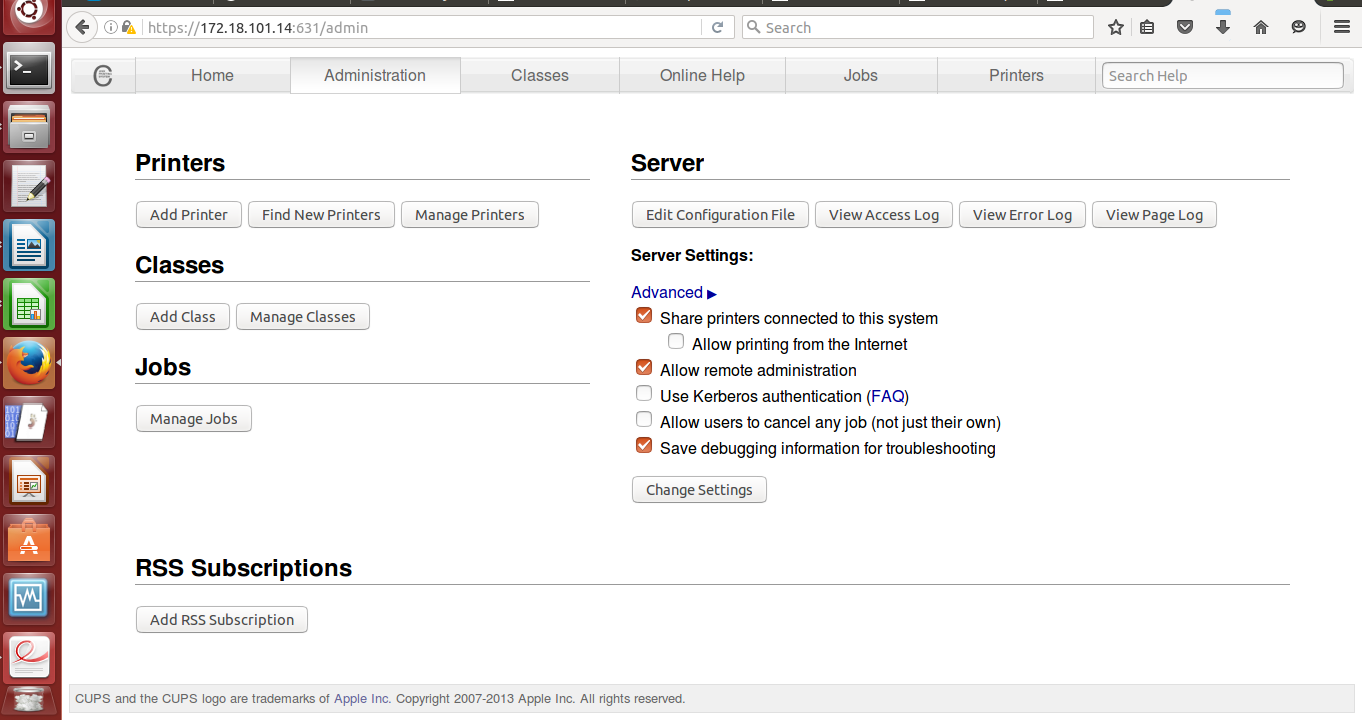
On all platforms, CUPS has a web-based administration interface that runs on port 631. It particularly helps the need to monitor print jobs and add print queues and printers remotely. This interface is with an enhanced administration interface that allows users to add, modify, delete, configure, and control classes, jobs, and printers. It Supports reports/ monitoring, Auditing and tracking of print queues . It will also do the centralized allocation /DE-allocation of Network printers to the users.
3.1 CUPS Web interface Home page

3.2 CUPS Web interface Administration page
 [edit]


4. CUPS quotas[edit]
CUPS supports page and size-based quotas for each printer. The quotas are tracked individually for each user, but a single set of limits applies to all users for a particular printer. CUPS logsevery page that is printed on a system to the page_log file. Page logging is only available for drivers that provide page accounting information, typically all PostScript and CUPS raster devices. Raw queues and queues using third-party solutions such as Foomatic generally do not have useful page accounting information available.
Structure at GSTN : The HP Laserjet Pro M202dw printers act as print servers and authenticate against the Samba AD.

5. CUPS Access Control.[edit]
CUPS allows to create a new or modify an existing printer in such a way that there is a user-based access-control in place. Thus we can allow or deny access to a certain printer based on the user name.
